
The Gunslinger
Tired after months of ambiguity, Milan owner Jerry Cardinale has taken matters into his own hands in typical American fashion. But it is Como who have taught everyone a lesson this season.

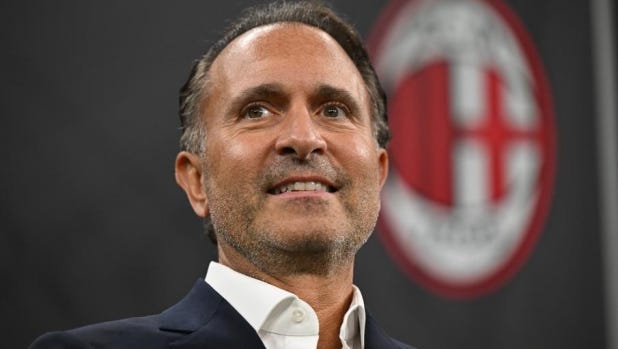
Having arrived last Friday expecting rapturous applause, he now leaves behind a club in ruins. These are strange days for Jerry Cardinale, founder of the RedBird fund which owns AC Milan.
In mid-March, after winning the second 'Derby della Madonnina' of the season against Inter, Milan were dreaming of a Scudetto push. Fast forward to the end of May, and they have slumped to a fifth-place finish. A dismal run of just 10 points from their final 10 games has cost them Champions League qualification, and an estimated €70m in lost revenue next season.
It was a calamitous end to the campaign, capped off by a 2-1 home defeat to a relaxed, already-safe Cagliari side. Perhaps the warning signs were there; all season, manager Massimiliano Allegri insisted a top-four finish was the ultimate goal, even when the Rossoneri were leading the table. But no one expected a collapse quite this severe.
Ultimately, the prophecy of Italian pundits and former players—most notably Daniele Adani and Antonio Cassano, long-time critics of Allegri’s pragmatism—has come to pass. Their mantra, “Father Time operates in silence,” rang true on the final day. Although Milan finished the season with seven more points than last term, failing to make it into the top-four, having already been dumped out of the Coppa Italia in early December 2025 and with no European fixtures to contend with, is an absolute sporting failure. For context, under similar circumstances last season, Antonio Conte won the Scudetto with a Napoli squad of comparable value.
The cracks had been showing for months. Milan rarely dominated games this season, relying instead on opportunistic moments, a trademark of Allegri’s style for years.
The Tuscan manager deployed a standard Italian 3-5-2 system that stifled the squad’s best talents, forcing Rafael Leão out of his natural winger role to play as a central striker, while leaving Christian Pulisic isolated and uncomfortable on the right flank, where he failed to score since late December. Compounding these issues was a chronic, season-long lack of a powerhouse centre-forward capable of guaranteeing goals. Harry Kane alone has scored more goals this season at Bayern Munich (61) than the entire Milan squad combined (58).
For most of the year, Milan survived on the work rate of 31-year-old Adrien Rabiot and the enduring class of 40-year-old Luka Modrić. But once their energy reserves emptied, the light went out. Last summer’s marquee signings, Ardon Jashari and Samuele Ricci, who cost a combined €55m, barely featured, overshadowed by their veteran teammates.
Defensively, the team frequently looked vulnerable, kept afloat only by goalkeeper Mike Maignan, whose performances prevented over 10 expected goals (xG). The January transfer window offered little relief. Bringing in Niklas Füllkrug yielded just a single goal, though in fairness, he battled through a broken toe for several matches. A late pursuit of Crystal Palace’s Jean-Philippe Mateta collapsed into a chaotic dispute over his fitness; Mateta went on to feature regularly for the Premier League outfit, scoring six goals from January onwards. This raises a glaring question: if the funds were available, why weren’t they spent sooner? Ultimately, a lack of a reliable number nine will wear any team down. Roma, by contrast, brought in Donyell Malen in winter and, thanks in no small part to his 14 goals, qualified for next season’s Champions League.
Much of the blame lies within Milan’s tangled chain of command. Chief Executive Giorgio Furlani, Sporting Director Igli Tare, and Technical Director Geoffrey Moncada all seemed to meddle without taking definitive accountability.
Adding to the confusion is the looming presence of Zlatan Ibrahimović. Formally employed by RedBird as a Senior Advisor to Cardinale, Ibrahimović’s role remains an enigma, characterised more by self-referential catchphrases and fleeting motivational visits to the Milanello training ground than clear executive action.
On Monday, Cardinale, a prominent supporter and donor of Donald Trump, resolved the crisis in true cowboy fashion. He pulled the trigger, delivering four swift “you’re fired” verdicts to Allegri and his three directors.
For American ownership, failure equals dismissal. We have seen a similar ruthless streak from the Friedkin family at Roma, who showed little hesitation in axing fan favourites coaches like José Mourinho and Daniele De Rossi.
Now, Cardinale is promising a more hands-on approach in Milan, starting with the appointment of a new manager. The criteria? A coach who can deliver attractive, attacking, and ultimately winning football. Milan is a vital piece of a broader global strategy for RedBird; it cannot be a loss-making enterprise. Financially, the ownership has done well, the club’s books are balanced, but the brand must project reliability and success.
Cardinale’s ambitions extend far beyond what happens at San Siro, which the club recently acquired, alongside Inter, and will invest to restructure. RedBird recently bough Paramount alongside Skydance in a massive $8bn deal, and they are currently working to bring an NBA franchise to Lombardy by October 2027.
“You see, it’s not just about Serie A. It’s about not showing up to the Champions League finals and losing 5-0; it’s about playing competitively in Europe,” Cardinale remarked just last week, taking a swipe at newly crowned Italian champions Inter following their heavy defeat against PSG last campaign.
Milan won’t have to worry about that particular problem next season. Confined to the Europa League, the Rossoneri face a long, patient rebuild.
Patience and meticulous planning are exactly what has driven success just a few miles up the road in Como, where the club secured a historic Champions League qualification.
Cesc Fàbregas has been coaching on the banks of the lake for four years. That’s a remarkable anomaly in a cash-strapped Serie A where clubs constantly cycle through managers due to an inability to attract elite talent. While Como’s project is backed by the wealth of the Indonesian Hartono brothers (ranked among the top 60 richest people globally), their success is built on structure, not reckless spending.
Despite having the financial power to outspend any team in Italy, Como focused on strategic investments, primarily targeting under-26 players with room to develop. Operating with only the 11th-largest budget in Serie A, they finished ahead of both Juventus and Milan.
The recently concluded Serie A campaign was widely criticised for its mediocre technical quality, characterised by the lowest goal average among Europe’s top leagues and a record-breaking 32 goalless draws.
Against this backdrop, Como have been a breath of fresh air.
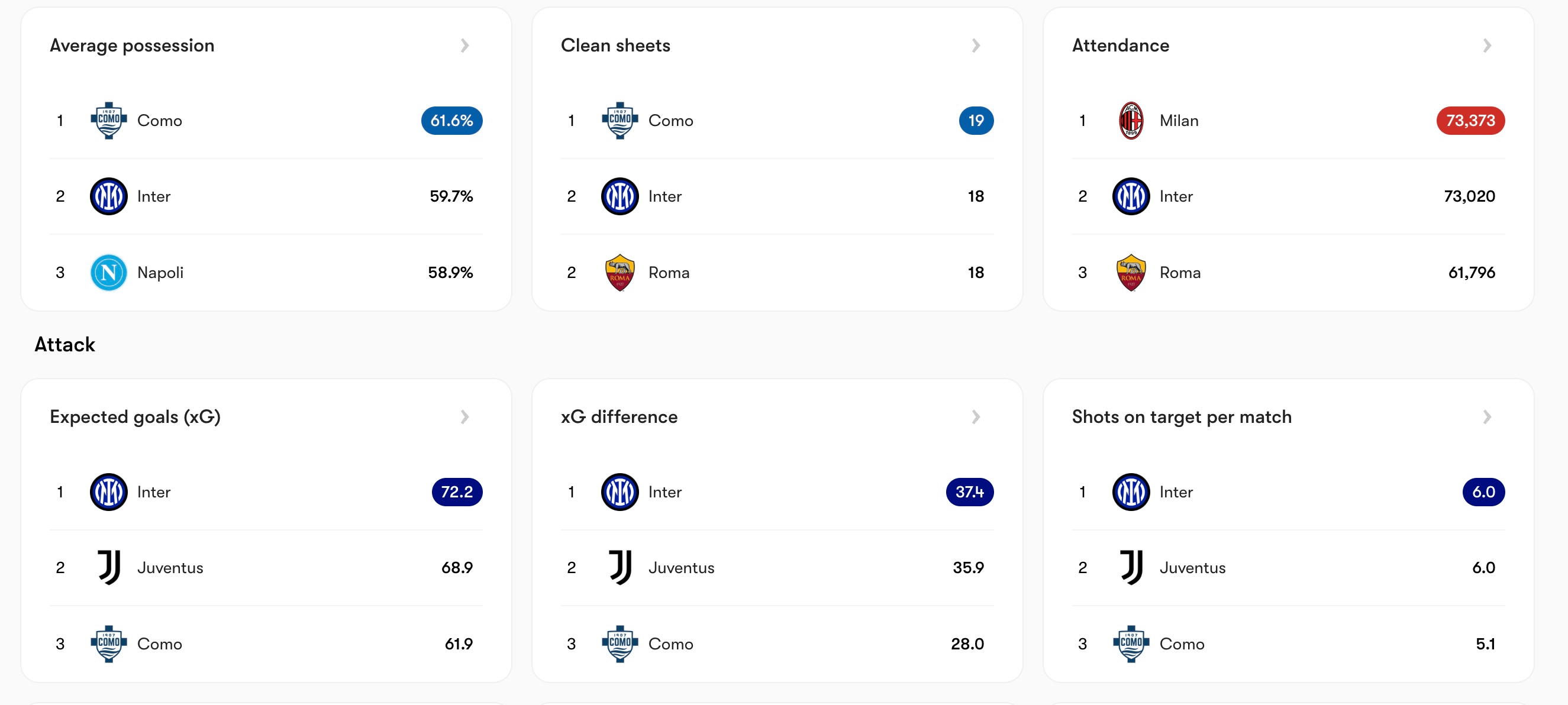
They proved that clear ideas can triumph, ending the season with the best defense in Serie A and the most clean sheets, while simultaneously ranking in the top three for key attacking metrics.
It represents a genuine cultural revolution. Fàbregas was previously criticised for a lack of pragmatism, notably after dominating but ultimately losing to Allegri’s Milan earlier in the season. In the end, however, it is Cesc who has had the final word.