
Run Away, Cesc
Italy is no country for football mavericks. The Como manager figured it out quickly, too.

“Winning isn’t important; it’s the only thing that counts.” This phrase is often erroneously attributed to Giampiero Boniperti—the Juventus icon of the ‘40s and ‘50s who later presided over the club in the ‘70s and ‘80s. The mantra became so synonymous with the club that, a few years ago, Italy’s most decorated side even had it printed inside the collars of their match kits.
In reality, Boniperti was merely quoting Henry Russell “Red” Sanders, the UCLA American football coach, in 1950. The line was later popularized by NFL legend Vince Lombardi during his tenure with the Green Bay Packers.
It’s hard to argue with the sentiment. In football—as in most team sports outside of the Olympic podium—there is no silver medal. Finishing second is simply losing. Defeats suffered “with heads held high” are usually met with more derision from rival fans than recognition of sporting merit.
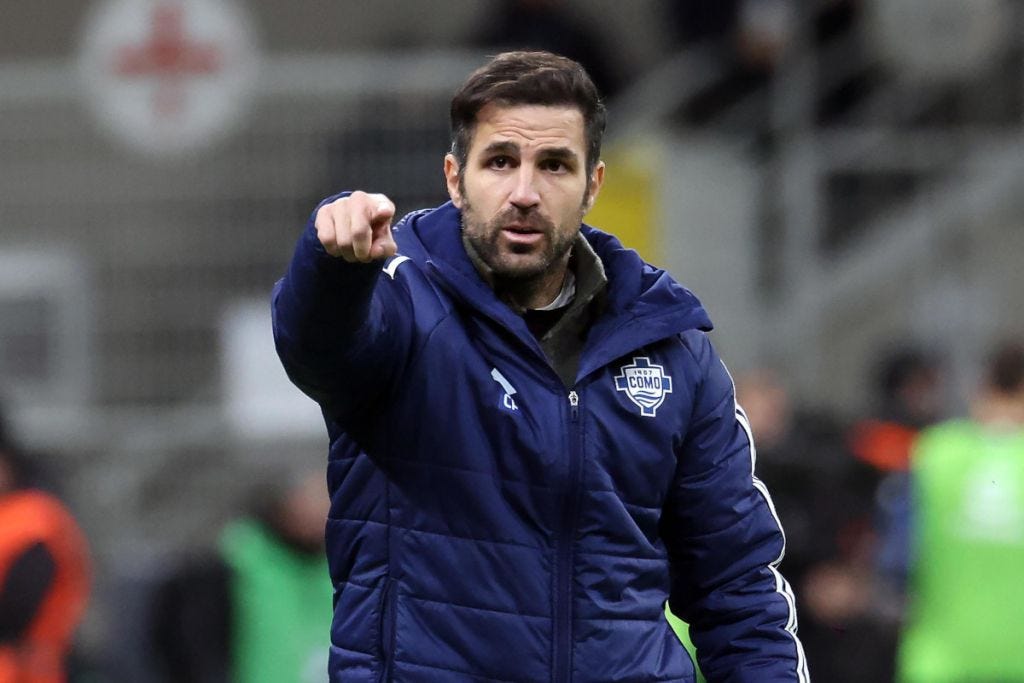
But the world of football is not an ecumenical community. There have always been those who choose a different path to reach the destination. The latest example in Serie A is Cesc Fàbregas. As a product of the Catalan school, forged by Arsène Wenger at Arsenal and a pillar of Spain’s era of tiki-taka and grueling possession, Fàbregas is a man for whom result and aesthetic are inseparable.
He is a “giochista” (an “idealist”), to use a trendy Italian neologism, set in opposition to the “risultatista” (the “pragmatists”)—the disciples of the school of Giovanni Trapattoni, José Mourinho, Antonio Conte, and Massimiliano Allegri. But labels are often reductive and risk obscuring the substance of the facts.
Fàbregas’ Como is undoubtedly one of the most visually pleasing teams of the season. He utilizes innovative training methods and has already built a distinct “brand.” They may be a “provincial” side, but they boast a budget that would make the league’s giants blush. This year alone, their net transfer spend sits at a deficit of €110.51 million. Since the project funded by the Hartono brothers—Robert Budi and Michael Bambang, among the 100 richest men in the world—took shape five years ago, Como has run a market deficit of €223.81 million. This is the third-highest in Italy, trailing only AC Milan and Juventus. Beauty, it seems, has a price.
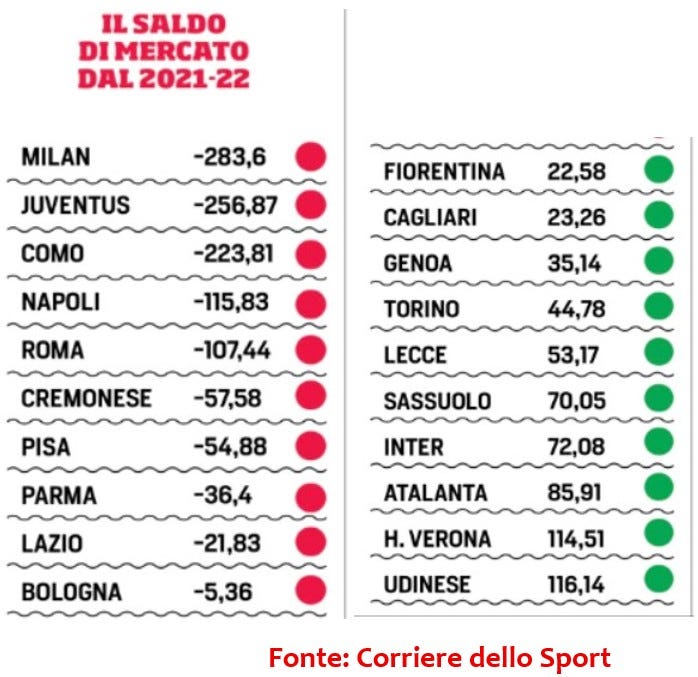
Como is, therefore, anything but a “small” club. And they play like a big one, battling with the fourth-youngest squad in Serie A (averaging 25.6 years) to qualify for the Champions League for the first time. One would expect nothing but praise, yet many are still turning up their noses.
Perhaps what some find hard to swallow is that there are virtually no Italians in the squad (Edoardo Goldaniga has made only two appearances).
“Between a young Italian and a young Spaniard, I always try to take the Italian, but you don’t have any!” Fàbregas explained this year, poking a finger into the wound of Italian football’s greatest ailment: a lack of patience.
“In Italy, if you play a youngster and he doesn’t convince immediately, you drop him. If I bet on a young player, he plays at least seven or eight games so I have a way to actually judge him.”
But the real storm was triggered by results. In mid-January, Como lost 3-1 at home to Allegri’s AC Milan in a match they largely dominated. They recorded nearly 2 xG (Expected Goals) against Milan’s little more than 1; 18 total shots against 7. Yet, the Rossoneri took the three points. Cornered by pundits in the post-match interviews, Cesc lost a bit of his cool.
“We made 700 passes against 200, I don’t know what to say,” the Catalan began. “1-3, 1-3, 1-3. The result was 1-3. Risultatismo—which you love so much here.”
Cue the uproar. The debate over whether it is better to win or play well was reignited, and Cesc was scolded for trying to “lecture” Italians on his philosophy. It’s the same treatment once reserved for Roberto De Zerbi, and before him, Zdeněk Zeman. They were labeled “beautiful but losers,” conveniently forgetting they never managed squads capable of truly competing for the title.
Fàbregas certainly made amends. In the following weeks, he tweaked Como’s tactical setup. In the return fixture at San Siro against AC Milan, he mirrored the Rossoneri with a five-man defense, looking to play on the counter. The result: 1-1.
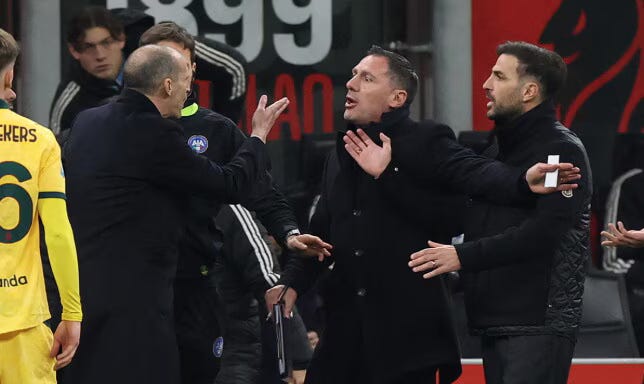
But what really grabbed the headlines was the incident with Allegri.
With about ten minutes left on the clock, Fàbregas tugged on Alexis Saelemaekers’ shirt to prevent him from dropping back into a defensive position. As a result, Allegri was shown a red card for—rightfully—defending his player.
The Spaniard apologised afterward, but the manager from Livorno wasn’t having it. As he was storming out of the press room, he shouted back at him: “You’re a child, you’re a prick—you’re just a child who’s barely started coaching!”
A few weeks later against Juventus, Como actually surrendered possession to the Bianconeri and attacked in transition, winning 2-0—their first away victory against the Turin club since 1951.
Yet even this display of flexibility and tactical acumen wasn’t enough to sway the critics of the “foreign” manager.
Last Tuesday, following a frankly soporific first-leg semi-final between Como and Inter, Cesc was asked if he had regrets about not going beyond a 0-0 draw at home. Yet, if there was one team trying to win the game, it was Como, while the Nerazzurri conserved energy for Sunday’s derby.
“Vindication through results? No, that’s for losers,” Fàbregas snapped.
“Regrets? I’d like to know how many times in recent years Inter has produced 0.07 xG.” The answer: the last time was two years ago.
Then came the controversy—a sterile one, admittedly—regarding the league schedule, as he highlighted the discrepancy in recovery time between Como and Inter. “Now we need to rest well because they’ve put our game on Saturday at 3 PM again, while Inter plays on Sunday,” the Spanish coach noted. This drew further criticism from those reminding him that TV rights decide the schedule in Italy—as if Fàbregas, with nearly 900 top-level appearances as a player, didn’t already know.
Serie A may not be the most spectacular league in Europe, nor the most intense. It is, however, certainly the most exhausting for managers. There is no unified metric for judgment, except for the result itself.
Well, they’ll stone you when you’re tryin’ to be so good
They’ll stone you just like they said they would
They’ll stone you when you’re tryin’ to go home
Then they’ll stone you when you’re there all alone.
So sang Bob Dylan in Rainy Day Women ♯12 & 35 back in the ‘60s, calling out social envy and conformism. He argued that no matter what you do—beautiful or ugly, good or bad—you will always be criticised.
Cesc—who turned down Inter’s advances last summer, fully aware that in Milan he would have been chewed up by the "victory-at-all-costs" meat grinder—has now realised that even Italy’s footballing provinces are not immune to this logic. And so, this summer, he will likely pack his bags to be welcomed with open arms by another league—the Premier League or La Liga (he would be perfect for Barcelona)—where results and aesthetics are finally allowed to walk hand in hand.