
Penalties, PR stunts and regrets
While referees admits their errors and politicians reward simulation, Serie A remains a hostile home for the mavericks

When “virtual standings” and alternative league tables begin circulating , it’s the universal signal that a season has taken a dark turn. The casus belli—though “chaos” might be the more appropriate term—was the final five minutes of Inter vs. Atalanta on Saturday.
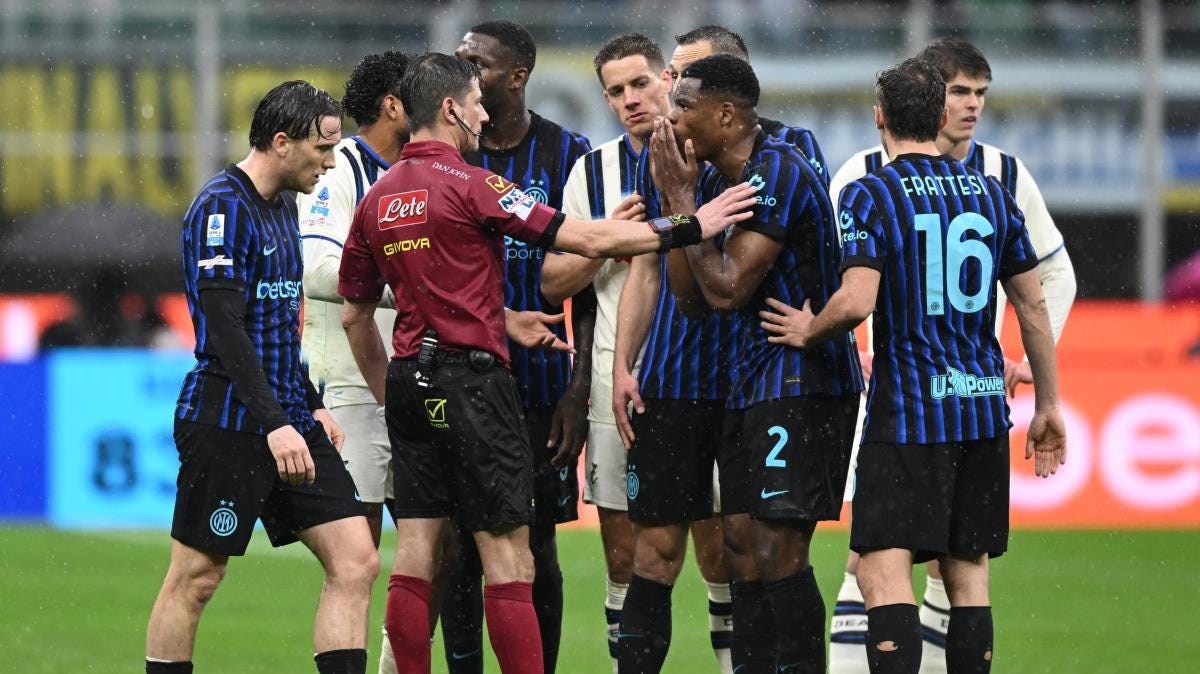
First, an Atalanta equaliser tainted by a slight nudge on Denzel Dumfries; then, a clear penalty claim for the Nerazzurri after a blatant kick from Giorgio Scalvini on Davide Frattesi. Both incidents were met with lengthy “silent checks” from the VAR, which ultimately upheld referee Gianluca Manganiello’s on-field decisions without ever sending him to the monitor.
Inter were left incensed and in silenzio stampa (media silence). The title race appeared wide open—until it wasn’t, following Milan’s slip-up at Lazio just 24 hours later. Yet, the atmosphere is now as poisoned as ever.
Enter the alternative table (see below, source: Telelombardia), based on “errors admitted by the Italian Referees Association (AIA).”
The association confirmed just hours later that the failure to award Inter the last-minute penalty was indeed a mistake. In its own arbitrary way, this table confirms a common sentiment among those not blinded by fandom: over the course of a 38-game marathon, refereeing errors tend to balance themselves out.
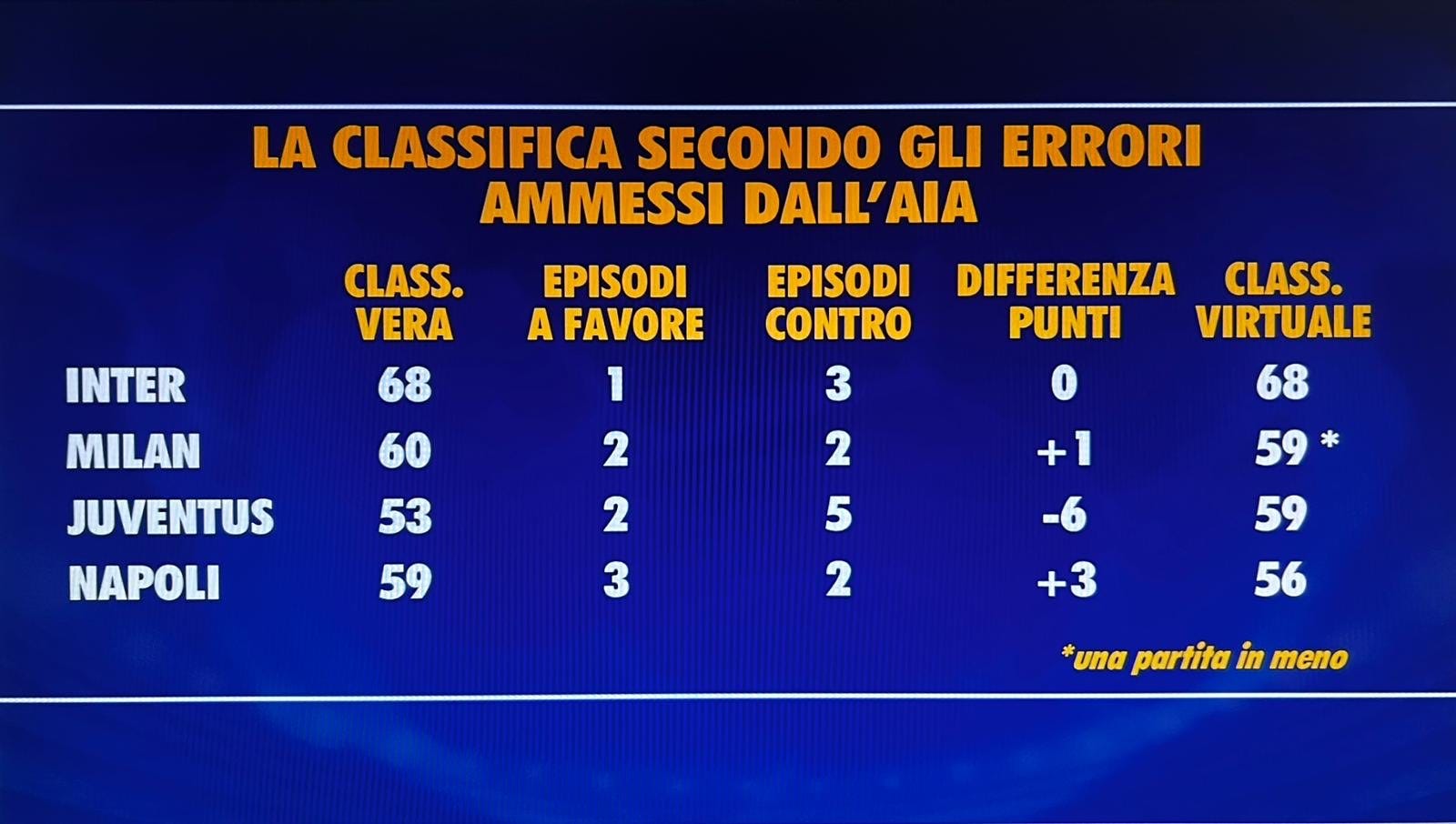
Take Inter, for instance. Today they feel like victims, yet their ledger includes the favourable dismissal of Juventus’ Pierre Kalulu—a match the league leaders might well have lost at 11v11. Conversely, they missed out on a penalty for Pietro Comuzzo’s foul on Pio Esposito (in a match that still ended 3-0 for Inter) and last week’s unpunished handball by Samuele Ricci in the derby. It is worth noting that even last-minute penalties still have to be converted.
To those who claim “the system” or the “powers that be” carry out these compensations scientifically, one should point out how difficult it is for officials and VAR operators to make decisions in a timeframe that feels infinite to the viewer but is, in reality, incredibly tight.
The VAR has not eliminated human error; it has simply moved it to a different level. To its credit, the Referees’ Association has been remarkably transparent, admitting to blunders and even facilitating the broadcast of official VAR dialogues on the Monday night show Open VAR. Yet, it is the 'grey areas'—where errors are not deemed 'clear and obvious'—and the ongoing misunderstandings of the protocol that continue to provoke upheaval.
In Italy, the grievance is that referees whistle too frequently, which then penalises teams in European competition. One can only hope that the 2026 World Cup and the introduction of a new VAR protocol—including checks for corner-kick deflections and second bookings—will finally lead to a consistent officiating line.
As mentioned, AC Milan failed to close the gap on Inter to five points, losing 1-0 to Lazio in Rome—mirroring their Coppa Italia exit last December. The Rossoneri’s approach on Sunday was uncharacteristic; for once, they didn’t wait for their opponent as they had in the derby, but instead utilised a high press from the start, almost like a desperate “Hail Mary.” Lazio, decimated by injuries, realised they needed a high-tempo start, attacking space with decisive sprints, knowing that once energy levels dipped in the second half, Milan’s ball retention would take over.
It was a stoic performance from Maurizio Sarri’s side—complete with his trademark dismissal for dissent—featuring an unplayable Gustav Isaksen and Mario Gila acting as a defensive bulwark. Beyond the perennial striker problem (Massimiliano Allegri chose to bench his only two options, Christopher Nkunku and Niclas Füllkrug), Milan missed Adrien Rabiot. For the Rossoneri, the Frenchman remains the difference between night and day: they average 1.50 points in the 10 games he has missed, compared to 2.50 when he is on the pitch.
Inter now need 20 points from 9 games to stitch the 21st Scudetto onto their shirts. Five wins and four draws would all but guarantee them the title, provided Allegri’s side wins every remaining fixture—and big matches like Napoli-Milan and Milan-Juventus still loom. However, further twists cannot be ruled out. Last season, Inter managed only 17 points in their final nine games; though they were deep in the Champions League and Coppa Italia at the time, and were ultimately pipped to the post by Napoli
Now, the Nerazzurri seem to be flagging; since Lautaro’s injury, they have scored just five goals in four league games, four of which came from set-pieces. But the captain returns this Sunday at the Franchi against Fiorentina, and Inter’s only remaining distraction is the semi-final return leg against Como.
While AC Milan’s Allegri has always prioritised a top-four finish, the real regrets lie with Napoli. Built to retain the title, they struggled with the dual burden of domestic and European football, exacerbated by excessive injuries. Antonio Conte will have to ask himself some tough questions. Yet, with the return of Zambo Anguissa and Kevin De Bruyne, the Partenopei could finish the season strongly.
Regardless of the outcome, Inter are set to receive an award this year: the relatively obscure “Rosa Camuna,” established by the Lombardy Region in 1996 to recognise “commitment, creativity, and ingenuity” in the region’s development.
Last month, Alessandro Bastoni was at the centre of the season’s most glaring refereeing blunder: his simulation led to Kalulu’s red card in the Derby d’Italia. The defender’s celebration at his opponent’s second yellow drew the ire of Juventus fans and neutrals alike. Since that day, Bastoni has been booed at every away ground. While such behaviour is crude, fans would eventually have grown tired of it. Instead, two local politicians have nominated the Inter defender for this “coveted” prize.
The citation reads: “He distinguished himself through the maturity shown in publicly recognising his error and taking responsibility for his actions on the pitch. This is a rare attitude that testifies to a respect for the game, opponents, and fans.” While it is a “brilliant” PR move for the politicians involved, it is likely a nightmare for Bastoni, who surely would have preferred to avoid further time as the scapegoat.
Cesc Fàbregas, the Como manager, seems equally destined for the pillory. He is clearly not winning any popularity contests among his colleagues or the establishment. On Sunday, he clashed with Roma’s Gian Piero Gasperini, who reportedly refused to shake his hand after Como’s 2-1 win. Predictably, that match also featured a refereeing error—the dismissal of Roma’s full-back Wesley—though not one publicly admitted by the AIA. Cesc is young and has had some ill-advised outbursts this year, famously reminding Italians that in Serie A, only the result matters, not the “how.”
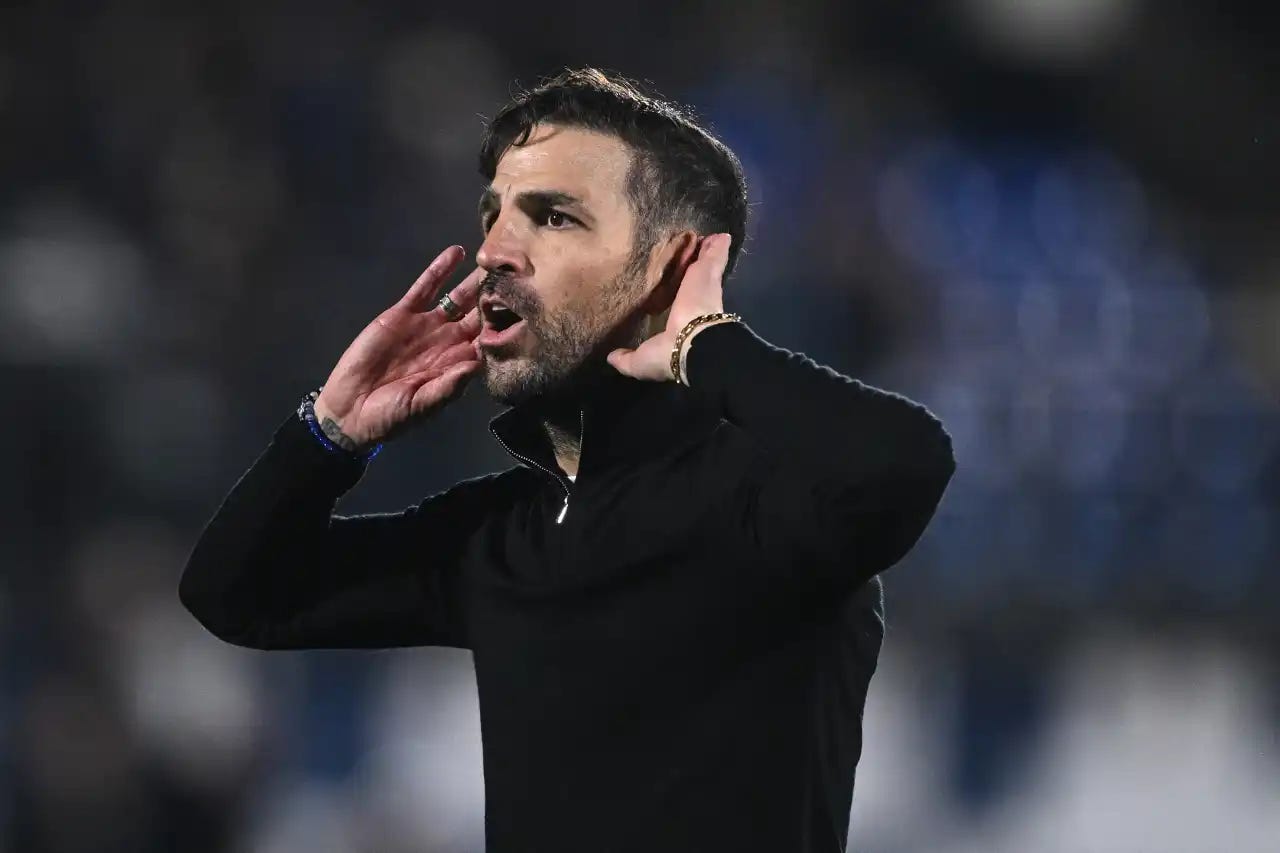
Yet, Como often outplays their opponents, and their young Spanish coach offers intriguing tactical solutions—sometimes bordering on arrogance. Against Roma, he opted for a striker-less formation, tasking one of his three centre-backs, Jacobo Ramón, with occupying the penalty area during the attacking phase to deny the Giallorossi defence a reference point. The gamble only half-worked; Ramón, perhaps due to a lack of familiarity with the role, missed two sitters in the first half. Como eventually scored when the actual striker, Anastasios Douvikas, came off the bench.
Italy, however, is no country for football mavericks. Rather than praising Fàbregas, the narrative consistently pits him against the more established, veteran pragmatists who 'get the job done.'
It has devolved into a guerra di religione—a holy war between the risultatisti (those who prioritise the result) and the giochisti (those who prioritise the play)—ideological labels that, now more than ever, have been stripped of all meaning
Como—a “small club” only in geography, given their substantial budget—deserves more credit. We will likely miss Cesc next season; it’s hard to imagine him staying in Serie A when he knows that in England or Barcelona, he would be far more appreciated.