
Sometimes They Come Back
Serie A scoring has hit a historic low. But while the strikers are in crisis, it is the creator who have truly gone missing. Now, Gattuso faces a defining choice...

As of today, sixty-two are missing. After 28 rounds of play in Italy’s top flight, goals are in sharp decline compared to last season. With 682 goals in 280 matches, the average sits at 2.44 per game—the lowest statistical mark in the last nine years. It goes without saying that among Europe’s “Big Five” leagues, Serie A is where the back of the net ripples the least (see below, source: La Gazzetta dello Sport).
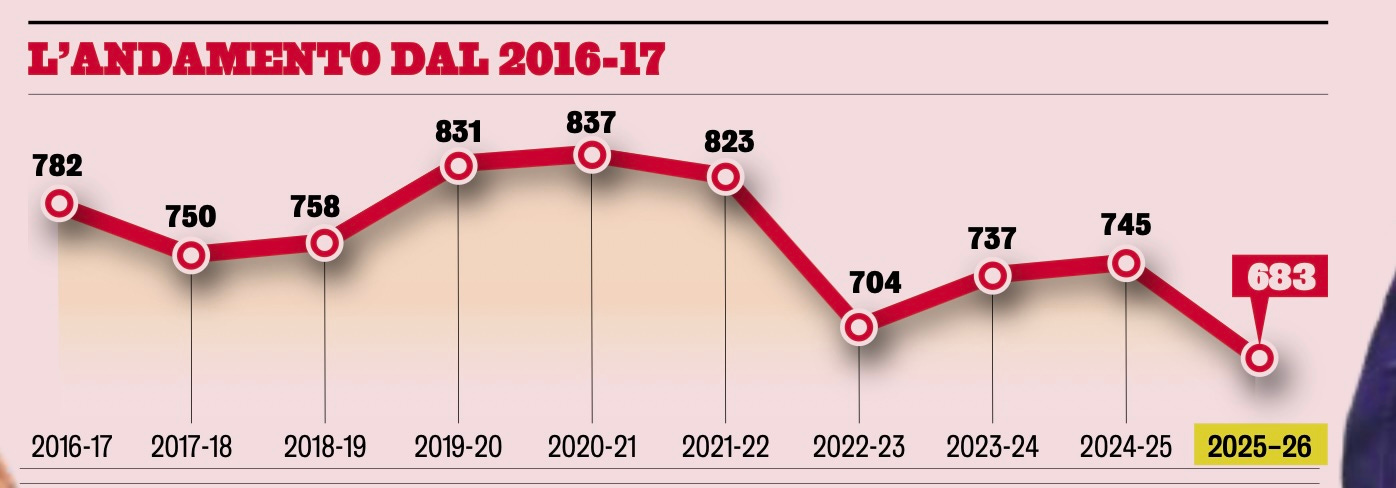
As witnessed in previous seasons, the Bundesliga remains the perennial outlier with an average of 3.19 goals per game. The Premier League and French Ligue 1 are cruising at 2.77, with La Liga trailing slightly at 2.66. Before this weekend, only one player in Serie A—Inter’s Lautaro Martínez—had reached double digits (14). The Argentine is currently sidelined with an injury, meaning he won’t be adding to his tally this Saturday. Behind him sit six players on nine goals, while the top-ranked Italians, Gianluca Scamacca and Moise Kean, are stalled at eight apiece. The comparison with the rest of Europe is merciless: the Premier League already boasts eight scorers in double figures, La Liga and the Bundesliga have ten, and France has six.
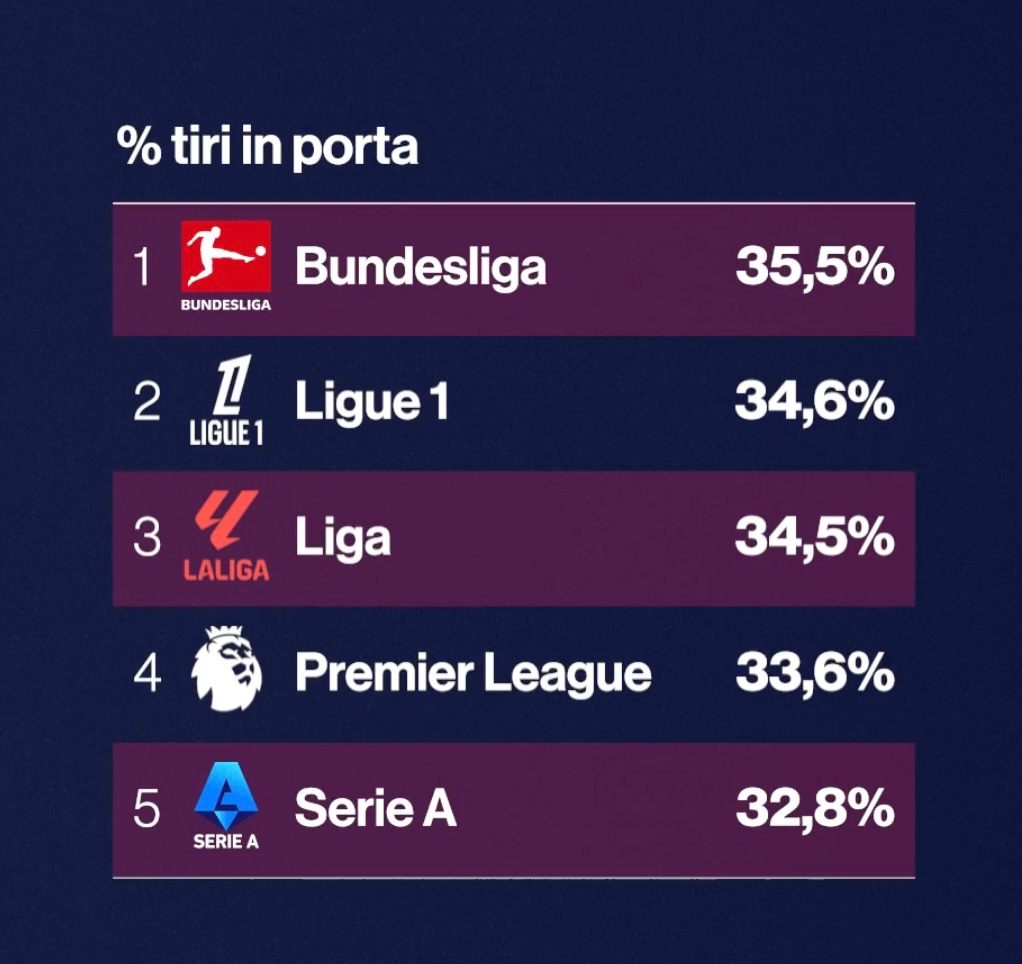
Is Serie A simply lacking clinical finishers? The data suggests it isn’t merely a question of quality in front of goal. First and foremost, Serie A teams are taking fewer shots (see below, source: La Gazzetta dello Sport).
Less than one in three attempts finds the target—another negative record among the top five leagues. This “minus 3%” gap compared to the Bundesliga may seem small, but on a macro scale, it makes all the difference.
Is it a case of Italian defenses being better prepared than their European counterparts? Not anymore. Until the mid-2000s, Serie A was the “University of Defending” for strikers; they came here to test themselves against the best center-backs and goalkeepers in the world. Today, those icons are also in short supply, a fact reflected in the goals Italian clubs concede in Europe. This season, the four Italian Champions League representatives (Atalanta, Inter, Juve, and Napoli) have played a combined 39 matches, conceding 63 goals—an average of 1.61 per game. Despite recent English defeats this week, their average remains much tighter at 1.14.
The problem, beyond a lack of tempo (Serie A remains one of the slowest leagues in Europe), is tactical.
The vast majority of Serie A sides employ a 3-5-2, often “mirroring” their opponents. This leads to low defensive blocks where the space to accelerate or thread a pass behind the backline vanishes. In this system, the burden of creating numerical superiority and scoring chances falls to the wide midfielders—once called wingers, but now rebranded with the neologism “quinti” (wing-backs). It is a tactically hybrid role, often filled by former full-backs or strikers who lack a clinical touch but possess massive engines. They are asked to perform the grueling task of covering both phases of play. In the best-case scenarios—take Inter’s Federico Dimarco, who already has 15 assists—the “quinti” provide inviting crosses.
However, by attacking primarily from the flanks, many Italian teams lose the ability to create chances in the “danger zone”: the classic imbucata, the through-ball that puts a striker one-on-one with the keeper. When games are deadlocked—as seen in Inter’s return leg against Bodø/Glimt—Serie A teams resort to systematic crossing. In that match, the Nerazzurri produced a staggering 46 crosses, a literal godsend for the Norwegian defenders.
An analysis of Expected Goals (xG) reveals that while Italy lacks finishers (having lost Victor Osimhen and last year’s top scorer Mateo Retegui recently), the real void is in the “creators”—the Number 10s and fantasisti who once flourished here.
The only two players in Serie A to crack the top ten for Expected Assists (xA)—a metric evaluating creativity by assigning a probability value to every pass—who play as true playmakers are Atalanta’s Charles De Ketelaere (3 assists from 6.5 xA, meaning his teammates wasted at least three clear-cut chances) and Juventus’ Kenan Yıldız (6.2 xA, resulting in 5 actual assists).
The rest are mostly wing-backs who pad their stats with set-pieces, a couple of central midfielders, and Luka Modrić, who plays almost as a “quarterback” for Milan—hardly the epicenter of the Rossoneri attack (see below, source: FotMob).
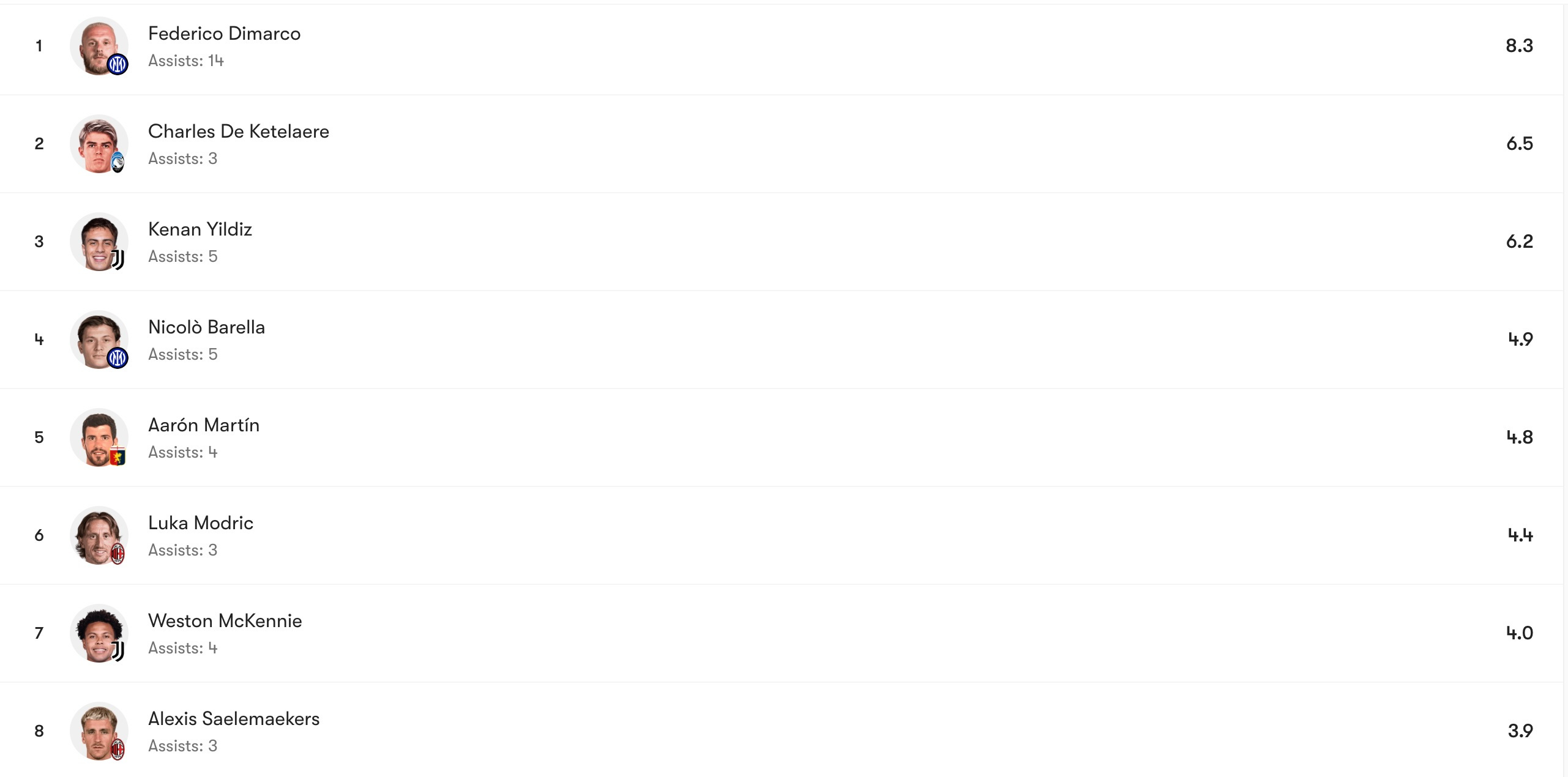
The contrast with the Premier League is stark: offensive players like Bruno Fernandes (8.5 xA), Rayan Cherki (6.5 xA), Bukayo Saka (5.7 xA), and Pedro Neto (5.6 xA) boast significantly higher values. Certainly, more goals are scored in England, but talented players are given more room to breathe and create, free from tactical cages. The story is the same in La Liga, where the xA charts are dominated by world-class talents like Lamine Yamal and Kylian Mbappé, alongside Arda Güler, Julián Álvarez, and Raphinha. While Italian clubs may no longer afford such players, the ones they do have should at least be allowed to express themselves.
Faced with this drought of goals and creators, Italy coach Gennaro Gattuso is weighing complicated choices ahead of the World Cup playoffs. Among the latest names being discussed is Federico Bernardeschi, who returned to Italy this season after three years in Canada with Toronto FC. On Thursday, Bernardeschi—one of the 2021 European Champions—scored his sixth goal of the season for Bologna in the Europa League against Roma. He is arguably playing with a flair not seen since his days as the enfant prodige at Fiorentina. Born a Number 10, he evolved by necessity into a winger and then a wing-back; currently, given the inconsistent form of Matteo Politano and Riccardo Orsolini, Bernardeschi represents the best Italy has to offer on the right flank. Yet, he hasn’t played for the Azzurri since 2022.
The same applies to Lorenzo Insigne. He, too, is back from a three-year Canadian stint, returning in January—albeit in Serie B—to attempt the “mission impossible” of saving Pescara, the club that launched him into professional football fifteen years ago. And it is not outside the realm of possibility that “Lorenzo Il Magnifico” might succeed with his trademark tiraggiro (the curled shot from the edge of the box).
“I talk to Gattuso every day,” Insigne recently told La Gazzetta. While romantic and fascinating, recalling a 34-year-old Insigne alongside a 32-year-old Bernardeschi would be a move born of desperation.
But despite the rhetoric that Italian football must promote courage and youth, Gattuso needs experience in this delicate moment. The Azzurri must face Northern Ireland on March 26th with humility; better not to think about a potential play-off final in Bosnia or Wales for now.
Northern Ireland’s manager, Michael O’Neill, has been moonlighting since mid-February as the manager of Blackburn Rovers, trying to save them from relegation in the English Championship. Most of his squad plays in the English second or third tiers. Just like Insigne. It is a sad truth, but to beat the 69th-ranked team in the world (North Macedonia, who eliminated Italy in 2021, are 66th), the Azzurri might have to climb down from their pedestal and meet their opponents on their level.