
Working slowly
Low rhythms and few sprints. Serie A is Europe's snail, as clubs demand everything immediately

And then there was one. The honour of Italian football is preserved, at least for a couple of weeks, thanks to Atalanta’s historic feat on Wednesday.
However, the discussion about the health of Serie A continues. “An unchallenging league,” is the notion that has been circulating for some time to explain the failures of Italian teams in European competitions. This theory emerged during the nine-year Juventus domination of Italy’s top flight from 2011 to 2020, and it persists today, supported by data and advanced statistics.
“Our football lacks intensity, it is too slow,” lamented former AC Milan, Juventus, and Roma manager Fabio Capello from Sky Sports studios following the Bianconeri’s elimination on Wednesday evening.
This sentiment is confirmed week after week, with a few rare exceptions. It’s no surprise that when a Serie A match approaches the intensity levels that fans in other countries are accustomed to, pundits and media often describe it as “worthy of the Premier League.” This was the case in the recent Inter vs. Napoli match. The reality, however, is that in a football world increasingly dominated by speed rather than technical precision, Serie A is Europe’s snail.
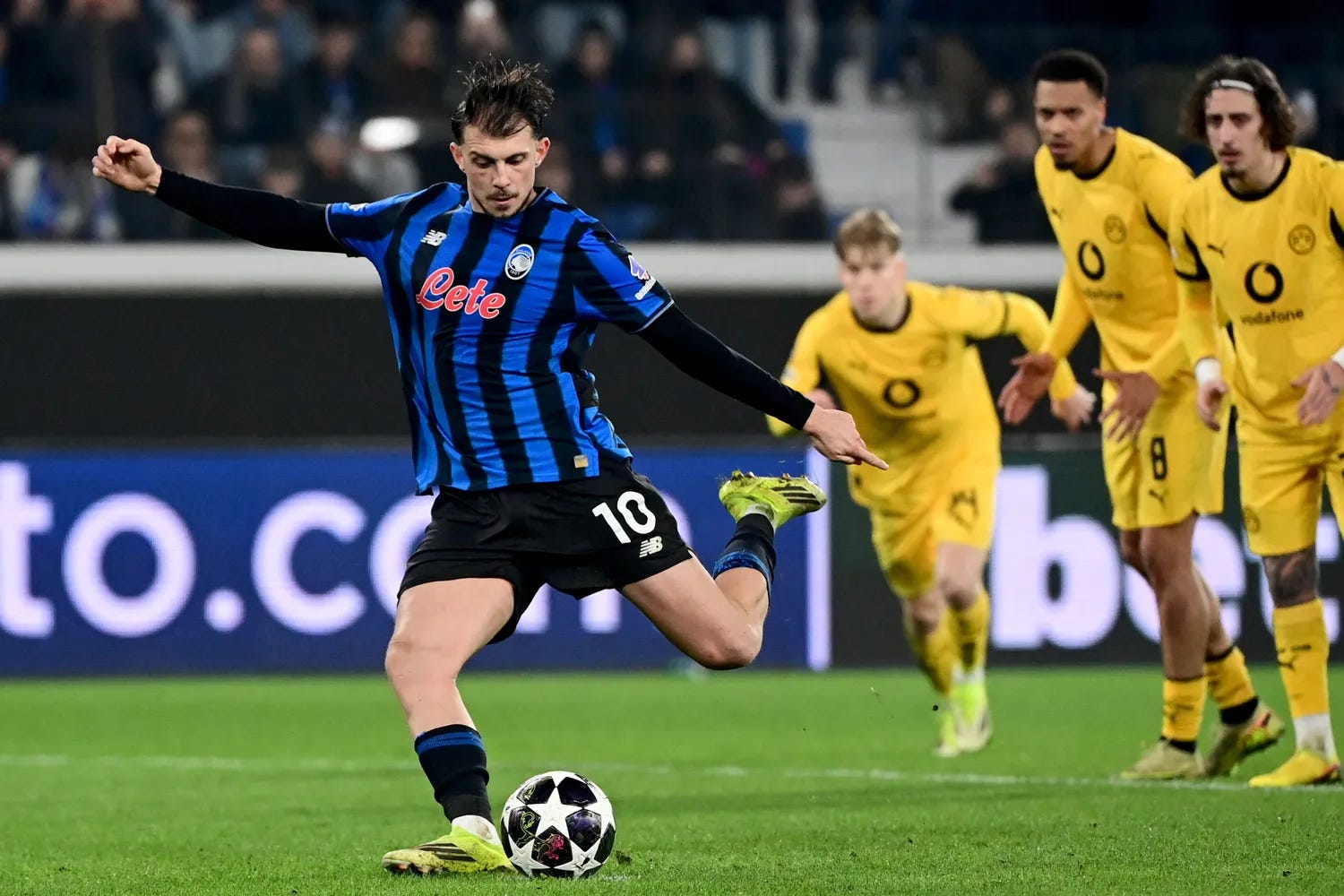
Serie A ranks second-lowest in direct speed of play among European leagues, with only the French top-flight having a lower speed. In the Champions League, the ball travels on average 10.4 meters per second, whereas in Serie A, it only moves 7.6 meters, far below the Premier League (10) and Bundesliga (9.4).
Data from the CIES Football Observatory has measured the average sprint distances in Europe’s major leagues, defining sprints as those lasting at least 0.7 seconds over 25 kilometres per hour. The Premier League leads with 199.6 meters, while Italy isn’t even in the top 10, trailing even the Norwegian Eliteserien and the Belgian league.
Of course, running more doesn’t necessarily mean playing better. “It’s better to let the ball do the running, it doesn’t sweat,” Roberto Baggio once said. However, too often this tendency of Italian teams to ‘lavorare con lentezza’ (work slowly) is synonymous with a tactical setup that is resistant to taking risks and obsolete.
It’s no coincidence that this weekend, 12 of the 20 Serie A teams will play with a three-man defense, a formation that now seems dominant among Italian teams. Despite tactical variations, from Simone Inzaghi’s Inter pushing defenders up almost as wingers to other teams fighting relegation defending with five men in a low block, the 3-5-2 system is primarily defensive, more focused on not conceding goals rather than outscoring the opponent. In such a system, “number 10s” struggle to find a place, and full-backs, typically defenders, are transformed into attacking wingers. Inter’s Federico Dimarco, a left-winger, has made 15 assists this year, but behind him in Italy, there is a significant gap.
A panacea for all evils to which Italian clubs, including the national team (albeit with little recent success), have resorted to remain competitive and attempt to win immediately.
In the 1990s, former AC Milan president Silvio Berlusconi disliked the three-man defense, convinced it couldn’t win in Europe and often clashed with his coaches (although Alberto Zaccheroni won the Scudetto with the Rossoneri in 1999 using a 3-4-3).
Beyond tactics, the key remains intensity, rhythm, and courage — elements that were missing for Inter and Juventus in their first-leg matches but which Atalanta displayed on Wednesday at home.
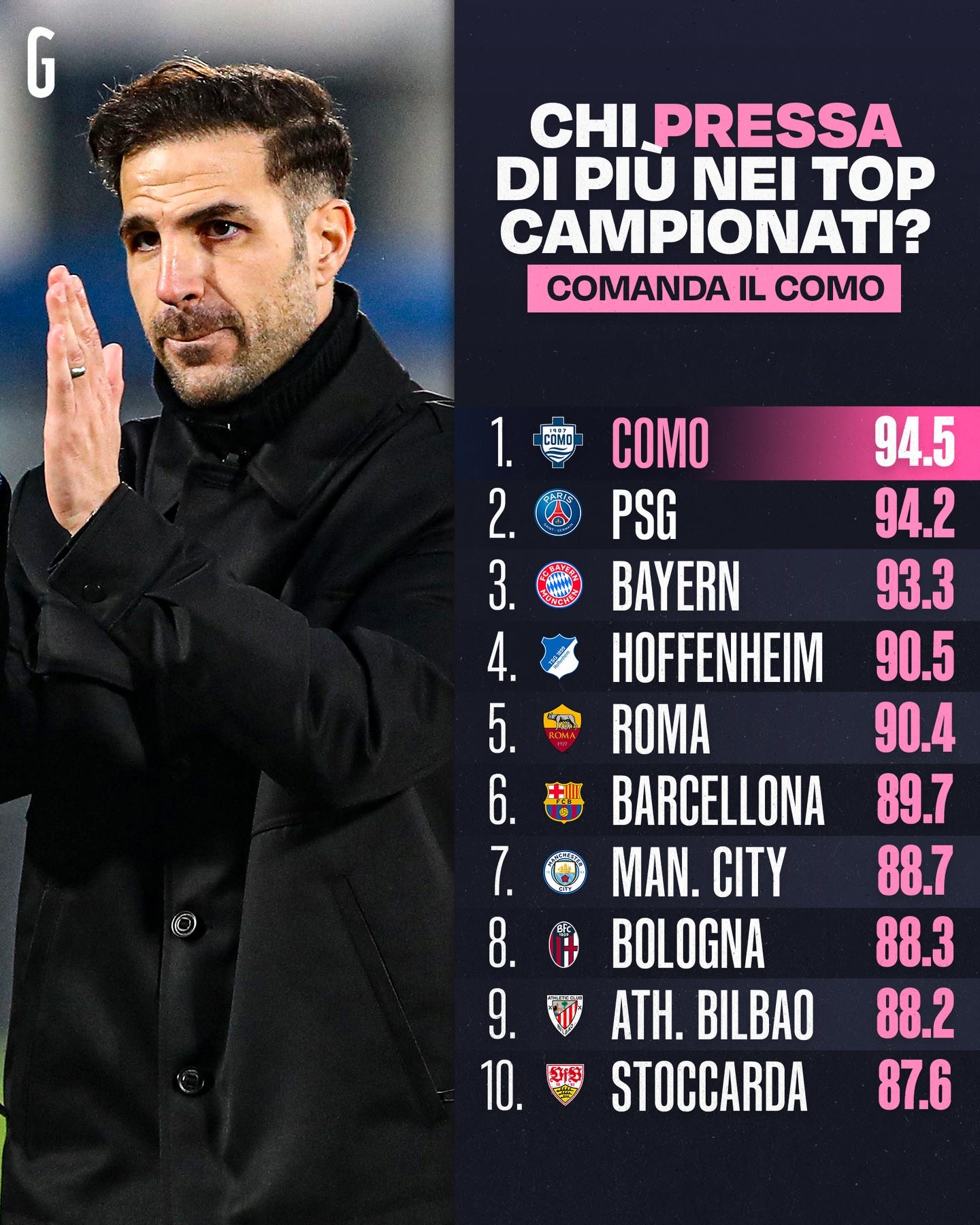
Then there’s the rush to achieve results, pressured by economic demands. In Serie A, the only manager who has been on the same bench for more than three seasons is Cesc Fabregas of Como, coincidentally the team that currently presses the best and most in Europe (see below). Most Italian clubs have little patience, giving their coaches scant time to experiment and, naturally, make mistakes.
Assessing the value of a football movement based on cup results is a complicated exercise and risks being misleading.
After all, football, a low-scoring sport, is heavily tied to incidents that can change the course of a match and a season.
Italian clubs still rank second in the UEFA coefficient over five years, much owed to Inter’s appearances in two Champions League finals, Atalanta’s success (Europa League 2024), Roma’s triumph (Conference League 2022), as well as Fiorentina losing two consecutive Conference League finals and the Giallorossi’s unfortunate final against Sevilla in 2023.
Not bad considering that, this year, Deloitte’s Football Money League saw no Italian teams in the top 10 wealthiest clubs in Europe.
The draw for the Round of 16 of European competitions was not favourable, with the Bologna vs. Roma derby being the matchup everyone wanted to avoid, but there’s still life in the old dog yet.