
Old Men, Young Game
Faces may change at the top, but fixing the shattered foundations of Italian football will be a generational task.
As is tradition in Italian football, the morning after a catastrophe is reserved for the inquests. The instinct is to tear it all down. “Everyone home!” screamed the front pages of the major sports dailies, sounding like a call for a popular uprising to dismantle the Palazzo, the very seat of footballing power.
Even without the tone-deaf post-match comments from FIGC (Italian Football Association) President Gabriele Gravina (pictured below), who bizarrely labelled the Azzurri “heroic” following their defeat to Bosnia-Herzegovina, his position would be untenable. At 72, Gravina was at the helm when Italy won the Euros in 2021, but also when they slumped to a play-off elimination against North Macedonia a year later. Despite the failure of Euro 2024, he was re-elected in 2025 with a staggering 98.6% of the vote, a plebiscite that felt increasingly detached from reality.
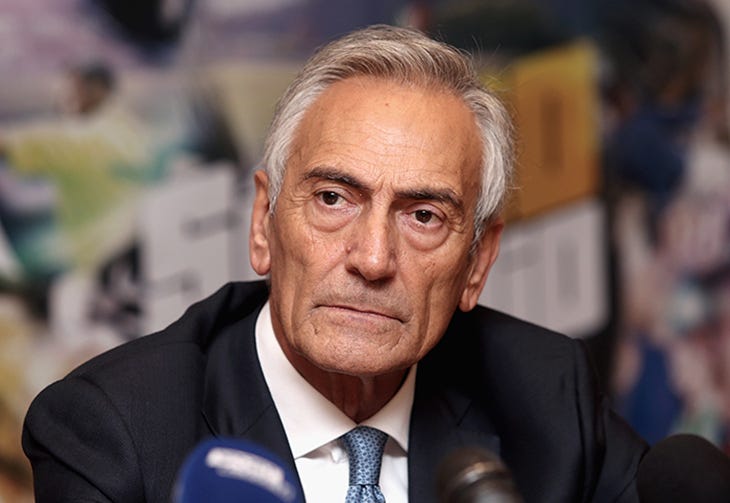
Following a third consecutive failure to reach the World Cup, the corridors of power in Rome have waded in. Sports Minister Andrea Abodi has called for a total “refounding” of the game, while Prime Minister Giorgia Meloni has reportedly intervened following pressure from 40 senators. Legally, their hands are tied; the FIGC is a private entity with organisational autonomy, funded largely by sponsorships and TV rights.
Yet, the national team has always been a political lightning rod. In 2000, after losing the European Championship final to France, then-Prime Minister Silvio Berlusconi publicly lambasted manager Dino Zoff for failing to man-mark Zinedine Zidane.
“Even an amateur would have noticed it,” Berlusconi thundered. “Zidane was free to create. We should have put Gattuso on him.”
Zoff resigned that same day.
Gennaro Gattuso, the man Berlusconi once demanded as a tactical solution, is now part of the problem. Invited by Gravina to stay on as a caretaker until June, the former AC Milan midfielder has instead walked away. Joining him in the exodus is Head of Delegation Gianluigi Buffon. Buffon was chosen for his charisma and the golden aura of 2006, but his executive experience was non-existent. It was he who pushed for Gattuso. Along with his fellow Juventus and Italy’s teammate, Leonardo Bonucci, they formed a technical staff defined by medals on their chests rather than tactical innovation. It was a “triumvirate of old glories” in a sport that had quickly moved past them.
The Italian FA’s greatest sin was a lack of planning. When coach Luciano Spalletti’s methods failed to land at Euro 2024, the FIGC should have moved for elite coaches like Simone Inzaghi or Carlo Ancelotti, both of whom became available last summer. Instead, after a 3-0 defeat in Norway led to Spalletti’s departure, they improvised, gambling that the “spirit of Berlin 2006” would be enough to carry this squad to North America. It wasn’t.
Perhaps then, as now, the situation required a deeper understanding of modern dynamics. But the path to reform is obstructed by the very structure of Italian football. The next presidential elections on 22 June will see 274 delegates cast their votes, but the real power lies with the Amateur League (LND), which holds 34% of the total vote. It is a paradox: in his post-elimination frustration, Gravina dismissed Italy’s successes in sports such as tennis, rugby or athletics as “amateur” compared to the “professionalism” of football. Yet, it is the amateur wing that effectively chooses the leader of the Italian FA.
The names currently linked with the vacancy are familiar faces: 75-year-old Giancarlo Abete, a former FIGC President (2007–2014), and Giovanni Malagò, who has presided over the Italian Olympic Committee (CONI) for the last 12 years.
The FIGC is a mirror of the country: ageing and stagnant. The average age of the leadership exceeds 60, higher than that of the Italian Senate (58.9). Of the top 20 executives, there is a total absence of those under 50, with the exception of Giorgio Chiellini and two women: Sara Gama (once the women’s team captain) and coach Silvia Citta. For the most part, it is a group of elderly men deciding the future of a game played by the young.
The decline was not an overnight event; it has been a 30-year slide. In 1994, Italy topped a “group of death” featuring Portugal, Scotland, and Switzerland to reach the World Cup in the USA. Today, with the tournament expanded to 48 teams, and three more European sides qualifying compared to 32 years go, the excuse that the qualifying format is “unfair” rings hollow. Italy simply isn’t competitive anymore.
For a quarter of a century, the production line of Italian match-winners has sat idle. Since 1994, only Fabio Cannavaro has claimed the Ballon d’Or. While the years leading up to 2006 saw a steady stream of Italians in the award’s top 20, the subsequent fall from grace has been vertiginous.
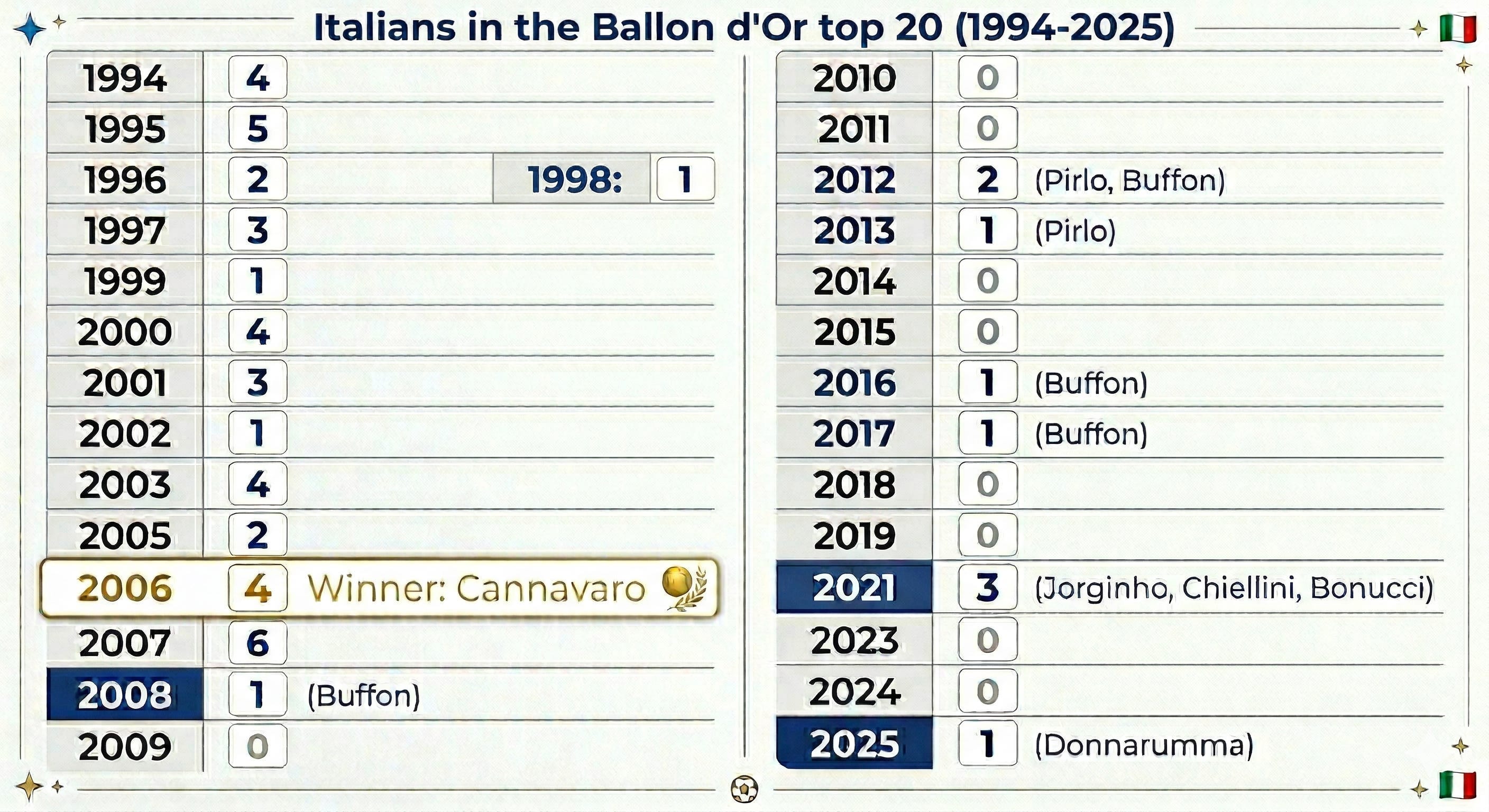
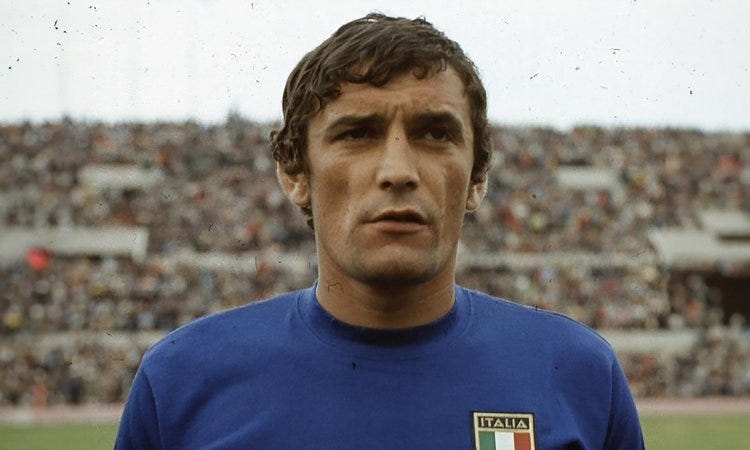
The “missing generation”, those born in the late 1980s and early 1990s, is almost entirely absent from the zenith of the world game. Today, the mantle of Italy’s finest belongs to Gianluigi Donnarumma. That he is a goalkeeper, following in the footsteps of Buffon, is the exception that proves a bleak rule: Italy no longer produces the creative, pacy wingers or clinical strikers required for the modern game. The national scoring record is still held by Gigi Riva (pictured below), who passed away in early 2025; his final goal for his country was scored in 1973.
The economic collapse of Serie A in the mid-2000s exposed the lack of investment in youth. Today, Italian professional clubs invest the least in Europe in their academies. In the Inter Milan Under-20 side (Primavera) that claimed the national title last year, there were 17 non-Italian players in the squad. Grassroots football has been outsourced to external clubs that charge families exorbitant fees. For the generation of Paolo Rossi or Francesco Totti, football was almost free. Today, it is an elite expense. Consequently, gifted children are migrating to rugby, volleyball, or tennis, disciplines that offer better facilities and structured pathways at a lower cost.
Beating Bosnia-Herzegovina didn’t require a revolution. It required Alessandro Bastoni to not get sent off and Moise Kean to finish a counter-attack in the second hald. But qualifying for the World Cup would have been nothing more than papering over the cracks, a temporary reprieve before an inevitable disappointment.
Italy is now at a crossroads. The system must be rebuilt from the ground up, a process that will take years. A national team must be entrusted to a new manager, and a European Championship must be organised in six years’ time. “I hope the infrastructure will be ready. Otherwise, the tournament will not be played in Italy,” warned UEFA President Aleksander Čeferin.
It is time to get a move on. For Italian football, the fear is that they will change the faces at the top while the rot at the foundation remains untouched.